Today in 10 Seconds
Gospel: Joy emerges from the deepest sorrow Rosary: Sorrowful Mysteries Pope: Young peacemakers needed, weapons spending questioned NPR: Abortion pill access expands across America ABC News: Five divers lost in Maldives cave Saint: Angels plow while farmer prays daily
— † —
John 16:20-23
"Jesus said to his disciples: ‘I tell you most solemnly, you will be weeping and wailing while the world will rejoice; you will be sorrowful, but your sorrow will turn to joy. A woman in childbirth suffers, because her time has come; but when she has given birth to the child she forgets the suffering in her joy that a man has been born into the world. So it is with you: you are sad now, but I shall see you again, and your hearts will be full of joy, and that joy no one shall take from you."
| ? |
Test Your Faith IQ |
Scripture |
|
|
In today's First Reading, Paul preaches in Corinth for 18 months. Who was the Roman proconsul of Achaia who dismissed the case against Paul, and why is this figure so important to biblical historians?
- A) Pontius Pilate, because his name appears in the Creed
- B) Gallio, because an inscription at Delphi helps date Paul's ministry
- C) Felix, because he later imprisoned Paul in Caesarea
- D) Festus, because he sent Paul to Rome for trial
Answer at the bottom of this newsletter.
|
 Photo: Vatican News
VATICAN NEWS
Pope Leo XIV made a special visit to Sapienza University, urging young people to reject resignation and become 'artisans of true peace' while warning against rising military spending and the dangers of an increasingly militarized world.
 Photo: NPR
NPR
The Supreme Court preserved telehealth access to the abortion pill mifepristone, expanding remote distribution of the drug nationwide.
| † |
FAITH & THE WORLD |
Jeremiah 1:5 |
|
|
"Before I formed you in the womb I knew you, before you were born I dedicated you, a prophet to the nations I appointed you."
Evangelium Vitae (John Paul II, 1995), CCC 2270
The Church's position is not primarily legal but ontological: every human life, from conception, carries the fingerprint of God (CCC 2270). John Paul II called this the "Gospel of Life" because it doesn't begin with prohibition but with a staggering claim about who you already were before anyone could see you.
Reflect → When you hear debates about 'access,' do you also ask access to what, and at whose cost?
|
 Photo: ABC News
ABC News
Five Italian scuba divers died in a cave diving accident in the Maldives, with rescue teams still searching the waters.
| † |
FAITH & THE WORLD |
Psalm 130:1-2 |
|
|
"Out of the depths I call to you, LORD; Lord, hear my cry! May your ears be attentive to my cry for mercy."
CCC 1014 (Preparation for death), Commendation of the Dying
The Church prays the "De Profundis" because death often arrives without appointment. The Catechism teaches that the Church "encourages us to prepare for the hour of our death" (CCC 1014), not out of morbidity, but because every goodbye could be the last one before the great hello.
Reflect → If today were your last, is there a conversation you'd regret not having?
|
 Photo: Positive.News
Positive.News
A listening project by Positive News is exploring what people truly value, asking how media can foster a healthier relationship with the world.
| † |
FAITH & GOOD NEWS |
Philippians 4:8 |
|
|
"Whatever is true, whatever is honorable, whatever is just, whatever is pure, whatever is lovely, whatever is gracious, if there is any excellence and if there is anything worthy of praise, think about these things."
CCC 2496 (Media and the common good)
Paul's letter to the Philippians reads like a content diet written two thousand years early. The Catechism teaches that the media has a duty to serve truth and the common good (CCC 2496); what we choose to feed our attention shapes the person we become.
Reflect → What did you read first this morning, and what does that say about what you're really hungry for?
|
| Rosary Mystery of the Day | |
| † |
Today's Mysteries |
Friday: Sorrowful Mysteries |
|
|
Sorrowful Mysteries
- 1. The Agony in the Garden
- 2. The Scourging at the Pillar
- 3. The Crowning with Thorns
- 4. The Carrying of the Cross
- 5. The Crucifixion and Death of Our Lord
|
|
|
|
The Objection
"Why do Catholics have seven sacraments? The Bible only clearly talks about baptism and communion. The rest seem like man-made rituals the Church invented later."
The Catholic Response
All seven sacraments have roots in Scripture, even if the word 'sacrament' isn't always used. James 5:14 describes anointing the sick with oil and prayer for healing. John 20:22-23 shows Jesus breathing on the apostles and giving them authority to forgive sins, which is the basis for Confession. The early Church Fathers, including Ambrose and Augustine, recognized these sacred signs as instituted by Christ, and the Council of Trent (1547) formally defined all seven, not as inventions, but as truths the Church had practiced from the beginning (CCC 1114, 1210).
CCC 1114 | CCC 1210 | James 5:14-15 | John 20:22-23
|

|
DAILY WORD GAME
Test your Catholic vocabulary
|
| † |
Saint of the Day |
May 15 |
|
|
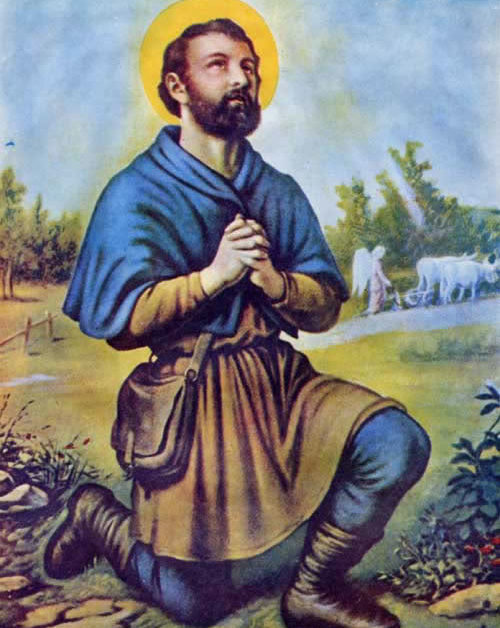
Saint Isidore the Farmer
Isidore was so committed to attending daily Mass before work that his fellow farmhands accused him of laziness. According to legend, angels were seen plowing his fields while he prayed, and his employer reportedly spied on him to catch him slacking, only to witness the miracle firsthand. He was a simple day laborer in 12th-century Madrid who never learned to read.
His feast is today, May 15, and his story of finding God in unglamorous daily work echoes the teens who found a world-changing discovery in their kitchen pantry.
|
Trivia Answer
B . Gallio's name was found on a stone inscription at Delphi dating his proconsulship to around 51-52 AD. This is one of the most important anchors for the entire chronology of Paul's missionary journeys and the New Testament.
|
|
